A writer admitted this to me after we’d worked together on her manuscript: she didn’t really want to work with an editor, but her writing mentor told her to, so she did. She thought editors were human spellcheckers and I’d just go through and fix her grammar.
She didn’t know what editing is, what it looks like, or what it would do for her story.
But once I’d given her a sample edit to show her what my process looked like? She was blown away. She realised I was going to do so much more than just fix her grammar and tinker with her commas.
Her reaction is common. The results of editing aren’t as obvious as getting your house painted. When you call a painter in, you can see their progress. They scrape off the old paint, sand back the weatherboards, putty any holes, lay down a primer coat, then paint the final colour. And now you have a fresh, glorious house to look at.
Editing goes on behind the scenes. First, you can’t see the progress in the same way as when your house is getting painted. You send me your manuscript, I work away for a few weeks, then you receive the edit back in your inbox. What’s going on in the meantime? What’s Deborah doing to my story? What will I get back? Does she even think it’s any good? The thoughts can swirl around.
Second, readers don’t see the process and progress of all your hard work, let alone mine. They just see the final, polished product. (Except when they spot the few typos that have managed to sneak their way past many rounds of revisions and edits. Trust me: that sucks.)
So let’s take a look at what really goes on when you work with me.
The process of reading (and listening)
The bulk of my editing involves reading the manuscript, as you’d expect. But I also listen to it. I follow along as the dulcet tones of Microsoft David, one of the generic English voices in Word, reads aloud to me. This stops me from skipping ahead, and it helps me catch awkward phrasing, typos, double-ups, and odd punctuation. Plus, my over-ear headphones keep my ears warm.

Along with reading and listening, I’m also pausing to check anything and everything.
Looking up info
As I read, I keep an eye out for all sorts:
- odd grammar
- funky spelling
- names of places, people, buildings and huts, mountains, pets, animals, rivers, deities
- punctuation punctuating the way it’s supposed to
- awkward, loose, or flat sentences, description, or phrasing
I pause a lot. I think a lot. Some changes are straightforward, but some take more time.
Straightforward changes can be anything like fixing dialogue punctuation, adjusting spelling, and tweaking grammar. But I’m also on the hunt for names, places, numbers, and facts, and that’s where Google comes in.
I do a lot of googling. Names, places, years, events, grammar conventions, distances, references to movies/books/TV popular and obscure. Editors have a saying: If you’re not sure, look it up. If you think you know, look it up. If you know you know it, look it up anyway. I have a cheat sheet for my how-does-this-word-work? situations: “licence” or “license”? Lay/lie/lying/laid??
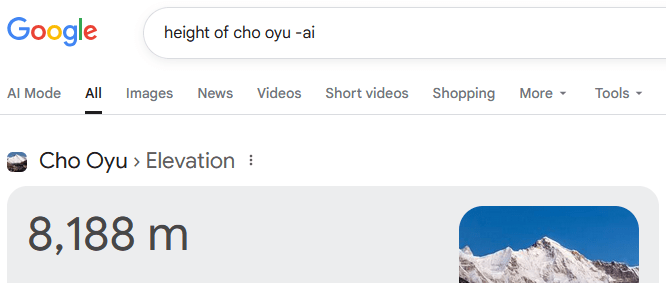
And as I read and check, I chuck a lot of words into my style sheet. That’s the document that records key info and spellings. Did you mention your mum’s birthday during a flashback? The date goes in the style sheet. Your favourite wine? Into the style sheet. The huts you stayed in on Te Araroa? Checked against the Department of Conservation website, and into the style sheet they go.
Merriam-Webster and Oxford Dictionaries are permanently open tabs. So is Word Hippo.

Comments
Leaving comments is a big part of my work. I don’t like to tell you what to change, and I don’t make changes without a reason. It’s your name on the cover, so you’re in charge of the story. My goal is to enhance your storytelling and help you tell the story that you want to tell.
So, I leave a lot of suggestions, and I explain my reasoning. It could be anything from tightening up wordy phrasing (to make the writing punchier and stronger), or suggesting a more direct word (to make descriptions and scenes more precise), or resolving a continuity issue (so readers don’t get confused). Check out these examples:

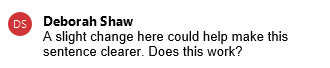

When I encounter a sentence that could be clearer or tighter or smoother or stronger, I give you examples of what could work (unless something has gone so wrong with the sentence that I can’t figure out what’s going on, but that doesn’t happen often). That way you can compare the original against the suggestion and see the difference. If you like it, you can use it word-for-word. If you don’t like it, you can either ignore the suggestion or come up with your own recast.
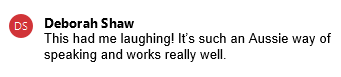
I also leave comments from my perspective as a reader so you can see how I’m reacting and how your jokes are landing. These types of comments show you what’s working (so you can do more of it!) and, I hope, give you a boost as you work through the edit.

Putting it all together
So, we’ve covered my process of reading (and listening) to your manuscript, the kinds of details I look up and check, and the types of comments I leave. And that’s just the first pass! All that stopping and starting doesn’t make for a smooth reading experience. So once I’ve done all this, I start again.
This second pass is much faster. I can see how the changes to the text work with the surrounding sentences, and I get a clear idea of how the story is coming together. The second pass also gives me a chance to spot anything I missed the first time through.
Now it’s a case of checking that my comments make sense, tidying up the style sheet, and putting together my editorial report (I’ll save the details of this for another post). Then I send the manuscript bundle back to you and you finally get to see what I’ve been up to.
I hope this has helped demystify the editing process. Different editors will take different approaches to their work, but the central aim is the same: to help you tell your story.
If you want to see what copyediting looks like on your own story, apply for a free sample edit. I’ll mark up 1,000 words so you can see how I would approach your work, the types of changes I’d make, and the style of comments I’d leave.
Discover more from Deborah Shaw Adventure Editing
Subscribe to get the latest posts sent to your email.
 Deborah Shaw Adventure Editing
One thought on “What editors do behind the scenes”
Comments are closed.